Posts

Operant Conditioning in the Classroom

Image
 One topic that was discussed that I found extremely interesting was about operant conditioning, and the influence it can have on encouraging or discouraging behavior. Specifically, I looked further into the effect operant conditioning can have when teachers use it in a classroom setting to manage student behavior. Effective classroom management is an important component of running a safe, nurturing learning environment that allows all the students the opportunity to learn without distracting behavior from others. If teacher understand the benefits and different ways operant conditioning can be used in their classroom, they may have less or no problems with classroom management.  Teachers can use operant conditioning to reward (reinforce) behavior that they want or punish (decrease) behavior that they don't want. When a student does something the teacher approves of, like raising their hand to answer a question, the teacher can immediately reward the student. This can be done ...

Systematic Desensitization Therapy

Image
 Systematic Desensitization Therapy is a type of behavioral therapy which treats phobias, OCD, PTSD, and anxiety. It uses relaxation and exposure in order to treat extreme fear and aversions. Its used by counter conditioning in order to teach a person a new response to a certain stimuli. The idea behind this is by using relaxation techniques during exposure to a certain stimulus will counteract the flight-or-fight response. Systematic Desensitization uses has three phases connected to it. The first phase entails teaching the client different relaxation techniques that will condition their original response to the aversion stimulus. The next phase is a collaboration between the therapist and client to create a "hierarchy" of intensity to clients different levels of exposure. The last phase desensitizes that stimulus by graded exposure in order for the client to practice the relaxation techniques and reverse their aversions during the exposure. To explain this better and exampl...

The Bobo Doll Experiment

Image
    If you don’t already know what the Bobo Doll Experiment is, it was an experiment done by Albert Bandura in 1961. He had tested 36 girls and 36 boys, trying to figure out if violence was a behavior that they learned from observation. All of the kids were between the ages of 3 and 6. He was trying to show modeling, and there were 3 different groups. One was an aggressive model, one was a non-aggressive model and the third group had no model, and that was the control group. Children were shown to individual rooms with their own toys and in that room with them, they watched either a male or female model that was behaving very aggressively towards a toy they called a “bobo doll” and while these adults attacked the doll, they were using a hammer in some cases, while others just threw the doll in the air making noises at it.       Children who had observed the aggressive model had made more imitative responses than those in the non-aggressive group or the...

Noneffective Parenting Styles and Their Impact on the Child

Image
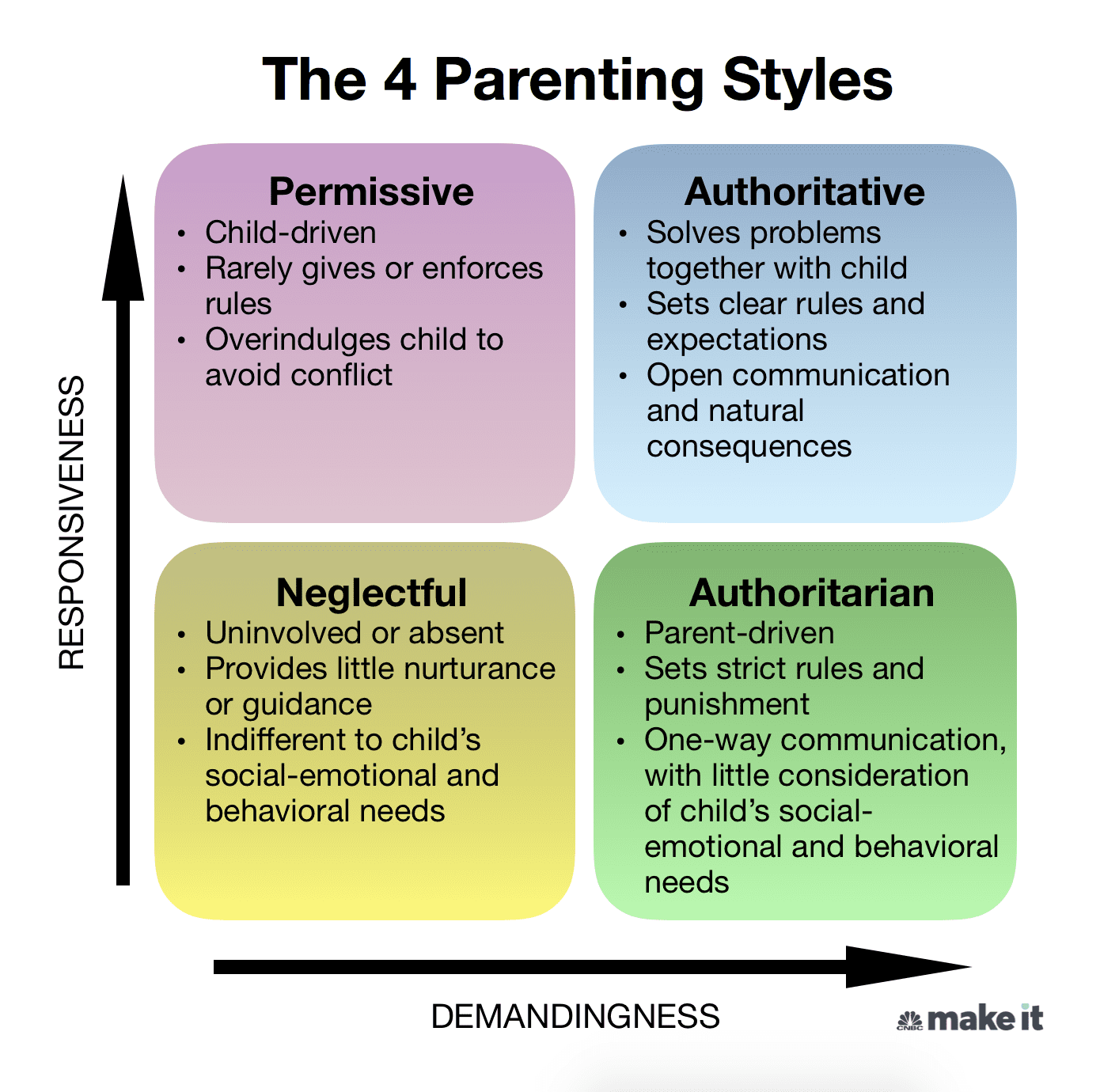
  Parenting styles play an important role in shaping a child's emotional, cognitive, and social development. While effective parenting can create positive outcomes, it is also important to acknowledge and understand the negative effects of noneffective parenting styles. A  peer-reviewed study conducted by Darling and Steinberg (1993) titled "Parenting Style as Context: An Integrative Model" provides insight into the impact of noneffective parenting styles on child development. The study examined three main parenting styles: authoritarian, permissive, and neglectful. Authoritarian parenting is characterized by strict rules, high demands, and little room for flexibility or open communication. The study revealed that children raised by authoritarian parents often experience lower self-esteem, decreased autonomy, and reduced problem-solving abilities. Permissive parenting involves an overly lenient approach, with few or no rules or boundaries set for the child. The study foun...

Operant conditioning and Children

Image
 Operant conditioning is a key factor in determining how children behave. The concepts of operant conditioning are frequently used by parents, caregivers, and educators to promote desired behaviors and reprimand undesirable ones. Children can be encouraged to engage in desirable conduct with the use of positive reinforcement. When a child exhibits positive behavior, such as finishing their homework or sharing with others, parents can reinforce these acts and improve the likelihood that they will occur again by giving incentives, compliments, or privileges. This strategy enables kids to connect their activities with positive consequences, encouraging them to keep up the desirable behaviors. On the other hand, using punishment to stop children from engaging in bad behavior is a sort of operant training. When used properly and regularly, punishment can teach kids about the negative effects of their actions and deter them from repeating those behaviors. However, it's crucial to remembe...

Unraveling the Magic of Observational Learning"

Image
Observational learning is distinct from classical and operant conditioning in that it does not rely on positive reinforcement or previous experience to be effective. Instead, it makes use of learning through emulation. How does this intriguing process actually function, though? Picture a kid watching their father use some tools to put together some furniture. A parent makes a thorough plan, gathers the necessary materials, and follows it to completion. The kid watches this whole thing with interest, even though they've never put together furniture before.The child will want to replicate what they have seen their parent do. They get together their own tool kit, watch their parent carefully, and then try to put together their own, smaller piece of furniture. Children learn by watching their parents successfully assemble something, and while they may make some mistakes along the way, those early observations serve as a guide. The youngster will become more adept at putting together fu...

Classical Conditioning: The Hidden Agenda

Image
The relationship between stimuli and responses is explored in this significant learning process, which Ivan Pavlov famously investigated with his salivating dogs. Our brains are wired to form associations, as shown by classical conditioning, which enables us to react to neutral stimuli as if they were the real thing. Then, how does this amazing procedure operate? Let's take a trip back in time to Pavlov's lab, where the canine salivation experiment was conducted. Pavlov observed that his dogs had an unconditioned response of salivation when offered with food. Seeing his chance, he included a jingle bell before delivering the meal. When this combination was repeated multiple times, an interesting phenomenon emerged. Soon, the dogs knew that whenever they heard the bell, their dinner would soon be ready. At some point, the ringing of the bell became an involuntary reflex, independent of the presence of food. Salivation in response to the bell had become a conditioned reaction to ...